Friday, November 8, 2013

Cambridge Drawing Society Autumn Exhibition

The Cambridge Drawing Society recently held its Autumn Exhibition  at the Leys School in Cambridge. Over 240 works were on display from drawings & paintings to prints and sculpture in what is a magnificent, almost cathedral like,  setting.
Over 200 people attended the Private View, including the Mayor, Councillor Paul Saunders. Sales were brisk, despite the economic downturn, and at the end of the exhibition, a healthy profit was achieved.

As usual, the public was asked to vote for their favourite painting and I am delighted to say that one of mine was selected. Titled "Ill Fares the Land", it is my commentary on modern day society. It is not a comforting painting to look at. Some people found it disturbing others said it was  thought provoking.
 
In my next blog, I will talk about the ideas behind it and how it was constructed.

Thursday, July 11, 2013

The art of the self portrait

Why do we paint ourselves? Is it for purely practical reasons when  no other models are available? Is it because you don't have to worry about the model not turning up, fidgeting, being bored or falling asleep? Is it because you are in total control of the production, or at least think you are.
Is it an act of vanity or deception ? This is how I would like the world to see me, minus the warts. Or is it an act of self revelation where you expose yourself for all  to see? Are you the  actor, the egotist, the victim or loner or any combination? How do different people read different things into the painting?

Below are various self portraits I have painted over the years. I leave you to draw your own conclusions.


Self portrait 1972


Self portrait 1979
 
 
Self portrait 1994


Self portrait 2012
 
 
A fascinating book on this subject is " A Face to the World" written by Laura Cumming and published by Harper Press


Sunday, July 7, 2013

The Worlington Movement

On Thursday, I was invited by my friend Heath Rosselli to visit her painting mentor, Rosa Branson, in London.

Both Heath and Rosa are highly successful professional artists working in the field of portraiture and charity commissions. They champion the use of traditional materials and techniques and have set up the Worlington movement to counter what they see as the appalling lack of teaching in these subjects  in present day art schools.

Rosa, now eighty, still paints for 7 hours a day. Her passion, enthusiasm and energy are truly inspiring. It was fascinating to see her vast canvasses in the flesh as we wandered round her home and studio. Disillusioned by the 5 years she spent at art school, she then studied under Dr. H. Ruhemann , chief restorer at the National Gallery in London. In order to preserve this knowledge she has written a book which is now in the process of being published.

Joining us for lunch was Prof. Michael Baum, one of Britain's leading cancer specialists and artist Israel Zohar. Mike is shortly to retire and has already taken up his interest in art, studying under Israel Z.

Over a generous  lunch, art dominated the menu as we explored the merits of traditional techniques versus reliance on technical aids and modern materials. It certainly produced some lively and entertaining discussions.


Friday, July 5, 2013

Exhibition at Brancaster Staithe

Last weekend, along with some students and friends, I took part in an exhibition at Brancaster Staithe on the North Norfolk coast. Having grown up beside the sea, it was good to get back to vast skies and the smell of salt air. The mud flats are very different from the sandy beaches of Scotland where I grew up, but they have a charm of their own and I do love painting them.

My task for the day, however,  was not painting en plein air, but to demonstrate portrait painting. It is much more fun than sitting behind a desk smiling endlessly at customers and potential purchasers! I decided as a challenge to paint two portraits in tandem. That way I don't fiddle around and come back to each painting with a fresh eye.

Both paintings were done in oils on canvas . Size 18" x 14". Stained with raw umber.

Each took around two hours, in between drinking tea and chatting to interested onlookers. All in all, a most enjoyable day


Pauline


                                                                            Mary
 

Tuesday, July 2, 2013

Bury St. Edmunds Art Society Annual Exhibition

The Annual Exhibition of the Bury St.Edmunds Art Society is on view at the Edmund Gallery in Bury until this Friday.I exhibited two works and  am delighted to say that I won the "Marjorie Miller Awar for a painting in oils."

 
This is a portrait of "Mary", my mother in law. If I am ever short of a sitter I pressgang her into it. She has been exhibited so often under many guises, she has become a bit of a minor celebrity in the town. People frequently stop her in the street and exclaim " I saw you at---". Others just stare, clearly trying to remember how they know her!

Forthcoming portrait workshops

I will be running the  portrait workshops in Grantchester Village hall, near Cambridge,  on Saturday27th July and Saturday 17th August. ( 10 am - 4pm)

The cost is £35 per day or £30 per day if both sessions are booked. ( Models, tea, coffee, and biscuits are provided in the price. Bring your own packed lunch.)

I will be explaining techniques and doing a demonstration as well as offering lots of individual guidance.
For further details or to book a place please e-mail  john@gloverart.co.uk or telephone me on 01284 810 460

Monday, July 1, 2013

Portrait Exhibition at Gallery Highwaymans

From the 6th - 28th July , I will be taking part in an exhibition of portraits at the Gallery Highwaymans at Risby near Bury St. Edmunds.The exhibition is a celebration of the work of Mary Beale, a 17th century artist from Barrow, the village where I now live.
On show will be her self portrait from the St. Edmundsbury  Collection prior to its inclusion in the Sainsbury Centre for Visual Arts, Masterpieces:" Art and East Anglia".

Alongside her work will be portraits by contemporary East Anglian artists. It promises to be a fascinating exhibition from the traditional to the avant - garde. Well worth a visit.

Saturday, August 18, 2012

How to create a nude in pastel

I really enjoy using pastel as a medium. It  is particularly well suited to achieving soft tonal gradations and the delicacy of skin tones.

This drawing is one of Lyn, a lady who models for lots of art classes and groups around the Cambridge area.
It was done on tinted Murano mount board using a range of different pastels. I use both Winsor and Newton and Senellier soft pastels , as well as charcoal ( willow sticks and charcoal pencils) and conte.


My initial tentative steps at placing the figure on the board are shown above. As can be seen, I didn't get it right first time, and changed the format to landscape. Frustrating, but there is no point in struggling on if the initial planning is wrong. This is done in charcoal. Here I am looking at rhythms through the figure, at basic proportions and angles. It is a very linear method and is only one way of approaching it. I will be considering alternative methods in future blogs.


As I am fairly happy with the basics, I now start blocking in the main masses paying a little attention to tone and colour. I say "little" because these are only the first tentative steps and I know that these will eventually be overlaid and modified. The darker areas are burnt sienna, the lighter tones naples yellow and yellow ochre. 


I now have to consider the background and begin blocking it in. I also make a start on the head. I am able to use soft pastels because very little fine detail is required on these larger areas. Sections like the head, hands and feet, I am careful not to overload and will dust them down before continuing on them. I use a combination of fingers, torchons and clothes to blend. How much blending one does is obviously a matter of personal preference or can be dictated by the subject matter. A wizened old man would suggest a bolder approach as opposed to the soft flesh of a baby.


The process continues. I pay more attention to light , shadows and reflected lights. I try to suggest the roundness of the forms and am also looking more closely at subtle colour variations within the flesh. I find myself adding cool blues and greens , overlaying them with softer pinks , sometimes blending them together , at other times leaving the colour underneath breaking through. This is a little like scumbling technique as used in oils. I am frequently asked what should my palette be? Everyone likes a formula it would seem. With pastels, I am a little at a loss for an answer. I have hundreds of pastels. The actual process is for me, to a large extent,  almost intuitive. I look closely and what I observe suggests a colour. Sometimes it seems a bizarre choice , but when blended works. Often, when I am doing a pastel demo to an art group, I start off using somewhat weird colours. It has a wonderful shock effect on the audience and certainly captures their attention. They clearly think I am mad! But the trick is to be able to pull the rabbit out of the hat and show
that by adding and overlaying, even this initial "disaster" can be turned into something pleasing.


When it comes to the head, I use a combination of conte crayons and pastel pencils then overlay in places with softer pastel.


The same approach is used when it comes to hands and feet.


Other areas are left softer and more diffused.


The finished drawing.


It was an attempt at a classical pose, both gentle and graceful. There was no desire to shock and reveal all. In many respects it is harder to capture the subtlety than present the viewer with a work where absolutely nothing is left to the imagination.

Perhaps that will be the subject of a future blog.

Friday, August 17, 2012

Painting with a palette knife.

Painting with a palette knife can be great fun. With it,  you can achieve a variety of bold textures you simply cannot get with a brush. Colours are mixed on the canvas and the resulting, often unexpected combinations, can surprise, and excite and be used to great advantage.
Paint is used straight from the tube and to increase volume one can also add things like Winsor & newton's Oleopasto or Rowney's texture paste.


To demonstrate some of the effects that can be achieved, I show a painting I did earlier this year.  "Colin's shed" . It is a large work measuring 48" x 36" done on MDF board.


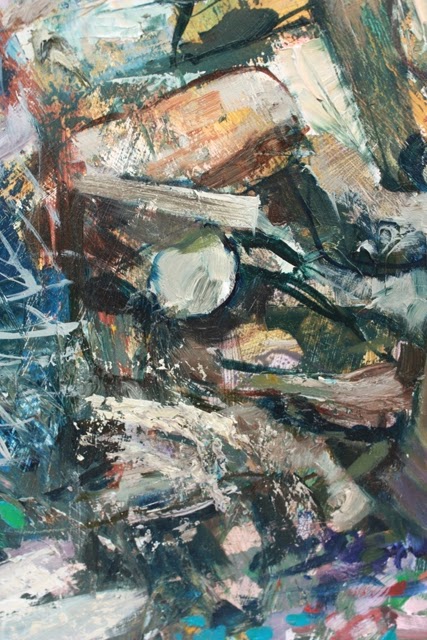
In the above, you can see the rich textures and ridges  created with a large trowel -like palette knife. Titanium white, Cobalt blue, pthalo blue and  Old Holland violet grey were all mixed and scraped around on the panel.

Another section of the painting began in an even bolder way. Scratching  into the paint, scraping bits off, sanding it down.


And again


 Doesn't look like much at the moment.

Let me show you a larger section of the painting.

Or this


At this stage I had to decide whether to simply use a palette knife or to combine it with brushwork and a more traditional approach.  I decided to do the latter, but still retain many sections which were looser and more spontaneous.


And so to the finished painting.

The first image above is of a section of  the roughly textured , plastered wall. The second is of the pile of logs by the stove.

The third, is the underpainting for the pile of assorted bric a brac on the workbench.

Sections of the painting in closer detail.

Or

As you can see, "Colin's Shed" is an almost magical place. Within it is an array of memorabilia, clutter and in some places downright junk. But it is a warm and inviting retreat, a place where one can feast one's eyes and take journeys into the imagination.


Tuesday, August 14, 2012

How to paint a young child and cuddly toys

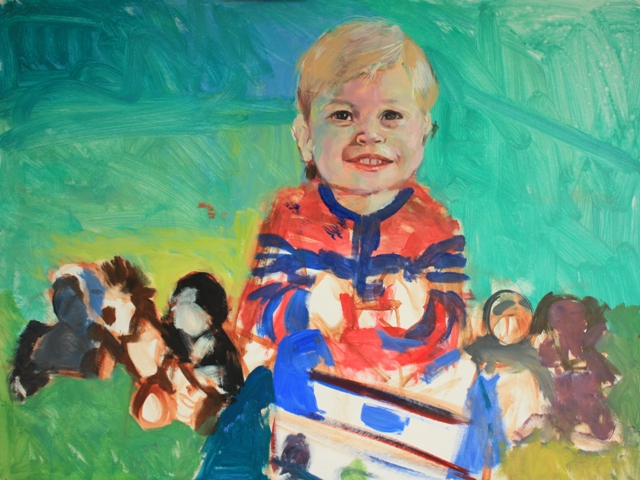
This was a recent commission. The challenge was to paint in oils this little lad surrounded by his favourite toys. At just over a year old, he wasn't for sitting still, so I had to resort to large number of photographs to work from. There then followed lots of discussion with his parents to see which, if any, captured him best.
In the end it was a combination of numerous ones which seemed to work best.

The painting was done on MDF board to which I had applied a couple of coats of acrylic gesso. To speed the process, I did the underpainting in acrylics.


I start by simply drawing with a brush and burnt sienna.


I start to lay in blocks of colour.


I tentatively position the features. The cool green of the underpainting is a nice foil to the warmer flesh tones on top. These are white plus yellow ochre, cad red.


Still working in acrylics, I now pay more attention to achieving a likeness, checking proportions and angles.


The temptation is to continue fiddling with the head, but I must move other parts of the painting along.


e.g. clothes, toys, toolbox and garden background.


I am now working in oils, to get the subtlety and softness required.

I am now at the fine tuning stage. Watch this space to see the finished painting and have my techniques explained in greater detail.


Saturday, April 28, 2012

Cambridge Drawing Society Annual Exhibition

Last week the Annual Exhibition of the Cambridge Drawing Society was held in the Guildhall, Cambridge. Over 280 works were on display. 26 candidates applied for membership, of whom 11 were accepted.
After the initial hand in day, the work really begins.
The selection procedure is first with nine members sitting on the committee, including myself as President. It is a totally democratic and ,of course,highly subjective  process. A different panel would come up with a totally different set of choices.

 
Selected work is laid out.

Later, screens are erected ready for the following day when everything is hung.
It can be somewhat daunting when faced with 280 works and an array of blank screens. Will we have enough, will we have too many? How to best balance them all colour wise , subject wise. It's rather like trying to do a large jig saw puzzle without the picture.

But I had a marvelous team  and the whole exhibition was hanging by lunchtime.


But then comes the fine tuning. Straightening pictures, labelling, cataloguing and , of course, preparing for the Private View.

The Private View was a great success with over 150 in attendance including the Mayor and Mayoress of Cambridge. A large number of paintings were sold and unfortunately , one was stolen. However, the police recovered it quickly after a tip off from a member of the public that a drunken man was lying on the ground at the bus station clutching a work of art. For the second year in a row we hit the headlines in the local press. Last year, a picture of a fish was stolen. This year, it was an owl. Perhaps a pattern is emerging?

The exhibition contained a huge range of styles, subject matter and mediums, from oils to acrylics, watercolours,etchings, wood engravings, mono prints and sculpture. Below, are just a few.


        Karen Stamper     Essaouria 1         Collage


      Stephen Roberts       " Dog Walkers, Grantchester"  oils


       Suzanne Parsonson   "Catching Up"   Graphite and Fabric


        Mohammed Djazmi      " Fallen"    Pencil


It was a great success as an exhibition with over 300 visitors per day, 89 works sold and sales of over £13,000.

The Cambridge Drawing Society's next exhibition will be at St. Faith's School in Cambridge from October 27th - November 3rd


Tuesday, March 6, 2012

Election week.

This last week has been a week of elections!

Firstly, I have just been elected President of the Cambridge Drawing Society.

Founded in 1882 by Lady Sandys it is one of the oldest Art Societies in the country and has over 140 members. Former members include Cecil Beaton, Ronald Searle, Gwen Raverat, Peter Graham, Vice President of the Institute of Oil painters and James Horton, President of the Society of British Artists.

Despite its title , it is not restricted to drawing but includes painting in every medium , sculpture, batik and limited edition prints.

Two Annual exhibitions are held, one in the Spring at the Guildhall in Cambridge and one in the Autumn.


This week I was also elected a member of ARTWORKS
Founded in 2000, this is a professional group of 30 East \Anglian based artists working in a range of styles and media. Their Annual Showcase Exhibition takes place in Blackthorpe Barn, in Rougham, near Bury St. Edmunds. ( 8th-30th September) Built in 1550, this magnificent timber framed building, is a wonderful venue to enjoy the work on display as well as see demonstrations by the various exhibitors.
For further information visit www.artworksinfo.org.uk

Pastels are not just for the young!

In my last post I championed pastels as an amazing medium for depicting young children. But it is wonderfully versatile and is equally good at portraying older people as well . Below is a recently completed pastel drawing of one of my oldest clients, Bill Joynson, who is 93.


A child's portrait in pastel

Pastel is a lovely medium in which to depict children. It has a delicacy and softness unrivalled by other mediums.
In this example I worked on a tinted Murano mount board using a combination of pastel pencils, hard and soft pastels. My initial drawing is done in a sanguine conte chalk.


Using Stabilo pastel pencils I begin putting in the details of the eyes.


And the mouth.


Fairly happy that these are in the right place, I can now turn my attention to larger areas of the face. I begin with pastel pencils and conte crayons but quckly turn to soft pastels to get the delicate blending I require. I use fingers, torchons or even cotton buds to do this.


The finished portrait of Annabel


Friday, February 3, 2012

Paint in Any Media with John Glover

It has been an incredibly busy start to 2012 with numerous portrait commissions, demonstrations to art societies and lots of new classes. Hence my blog has been somewhat neglected.

A new venture for me are two classes I am teaching at West Norfolk Arts Centre near King's Lynn.
Called "Paint in Any Media" they cover all media, from watercolours to oils, pastels, gouache. They are two very lively groups of students working in a diversity of subject matter and styles.

The classes are on Tuesdays from 10.30 - 12.30 and 1.30 - 3.30

For fuller details contact either Richard or Ros at the Centre on 01553 631 689 or check out their website at www.westnorfolkarts.co.uk

The Royal Institute of Painters in Watercolours

I was delighted to learn yesterday that I have had a portrait accepted by the Royal Institute of Painters in Watercolours. Competition was fierce with nearly 900 entries.

"The Institute has come to be recognized as one of the leading national institutions for watercolour painters, spanning figurative, abstract and experimental work."

Founded 181 years ago, it is their 200th London exhibition. It will be held at the Mall Galleries, near Trafalgar Square, between 14th -25th March.

For details of the exhibition and all other societies which exhibit at the Mall Galleries go to www.mallgalleries.org.uk

Friday, November 4, 2011

Success at the Cambridge Drawing Society Exhibition

Last week, the Cambridge Drawing Society held its Autumn exhibition at St. Faith's School in Cambridge. It was a large display, with over 200 paintings on show. There was a huge diversity of techniques and subject matter. They ranged from watercolours to pastels , oils, acrylics, etchings and sculpture. There was something for all tastes whether it be landscape, portrait, life, or abstract.

The public were asked to vote for their favourite work and I am delighted to say that two of my paintings were in the top three.

" Paul" came first.


"Michael" was second equal.


Thursday, September 22, 2011

Facing Hard Times International Open Exhibition

I have just had a portrait accepted for the "Facing Hard Times" International Open Exhibition in King's Lynn.
"The broad concept of the exhibition is the impact of recent global economic crises on all our lives".

A portrait from my "Homeless" series seemed appropriate.


The exhibition will be held at Greyfriars Art Space, 43 St. James St. , King's Lynn, Norfolk and will run from 1st -15th October

Monday, September 19, 2011

The Sentinels


In the Abbey Gardens in Bury St. Edmunds stand the ruins of the original abbey.

As I wandered round these, the remains of a large central arch loomed dark against a stormy sky. Suddenly, these crumbling columns appeared as two almost menacing figures. Hence the title of the drawing.

It was created using the same techniques as described in my previous blog.

Sunday, September 18, 2011

Fun with mixed media

On occasions it is fun to try something completely new.

Recently, I came across the remains of this wonderfully old gnarled tree. It was tortured and twisted, and bleached by the elements. I really felt I had to draw or paint it.

What would be the best approach? In the end, I decided to just play and enjoy the process of seeing how things developed.

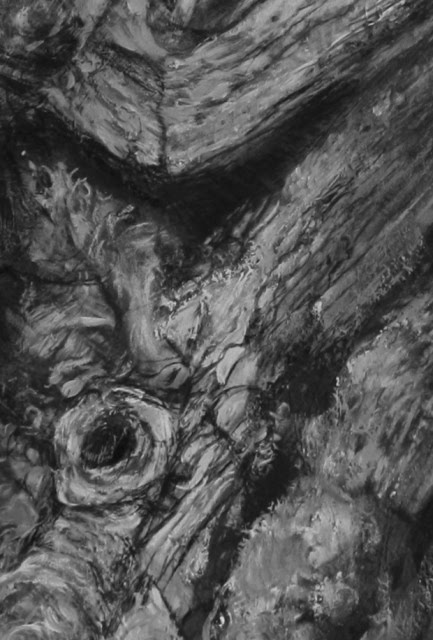
I primed a piece of MDF with acrylic gesso and blocked it in with charcoal. But it lacked the power and texture that I wanted. I added acrylic texture paste , modelling it with brush and palette knife to suggest the contours of the tree. When dry, I dragged charcoal across the surface. Black lava , sand, and glass bead texture gels also became part of the process. White conte chalk and black and white acrylic paint were used as well.

Below are a couple of close ups of the effects achieved.


Finally, the finished work, measuring 30" x20"