Showing posts with label palette knife. Show all posts

Friday, August 17, 2012

Painting with a palette knife.

Painting with a palette knife can be great fun. With it,  you can achieve a variety of bold textures you simply cannot get with a brush. Colours are mixed on the canvas and the resulting, often unexpected combinations, can surprise, and excite and be used to great advantage.
Paint is used straight from the tube and to increase volume one can also add things like Winsor & newton's Oleopasto or Rowney's texture paste.


To demonstrate some of the effects that can be achieved, I show a painting I did earlier this year.  "Colin's shed" . It is a large work measuring 48" x 36" done on MDF board.


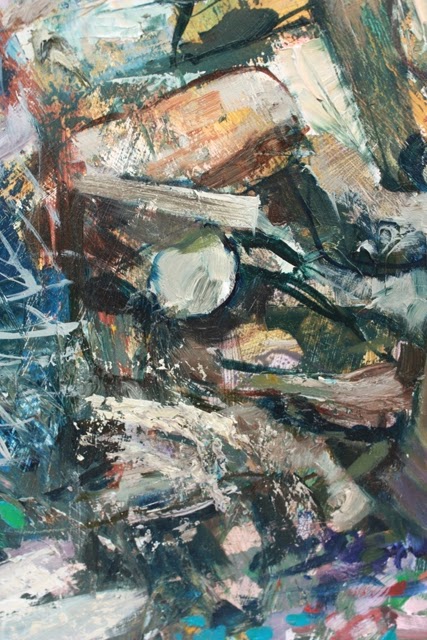
In the above, you can see the rich textures and ridges  created with a large trowel -like palette knife. Titanium white, Cobalt blue, pthalo blue and  Old Holland violet grey were all mixed and scraped around on the panel.

Another section of the painting began in an even bolder way. Scratching  into the paint, scraping bits off, sanding it down.

And again


 Doesn't look like much at the moment.

Let me show you a larger section of the painting.

Or this


At this stage I had to decide whether to simply use a palette knife or to combine it with brushwork and a more traditional approach.  I decided to do the latter, but still retain many sections which were looser and more spontaneous.


And so to the finished painting.

The first image above is of a section of  the roughly textured , plastered wall. The second is of the pile of logs by the stove.

The third, is the underpainting for the pile of assorted bric a brac on the workbench.

Sections of the painting in closer detail.

Or

As you can see, "Colin's Shed" is an almost magical place. Within it is an array of memorabilia, clutter and in some places downright junk. But it is a warm and inviting retreat, a place where one can feast one's eyes and take journeys into the imagination.


Sunday, September 18, 2011

Fun with mixed media

On occasions it is fun to try something completely new.

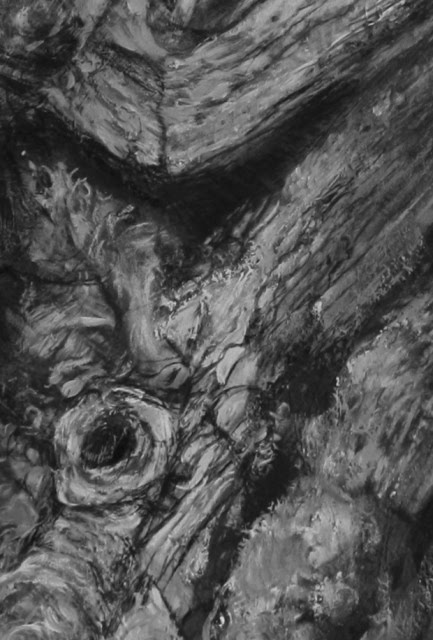
Recently, I came across the remains of this wonderfully old gnarled tree. It was tortured and twisted, and bleached by the elements. I really felt I had to draw or paint it.

What would be the best approach? In the end, I decided to just play and enjoy the process of seeing how things developed.

I primed a piece of MDF with acrylic gesso and blocked it in with charcoal. But it lacked the power and texture that I wanted. I added acrylic texture paste , modelling it with brush and palette knife to suggest the contours of the tree. When dry, I dragged charcoal across the surface. Black lava , sand, and glass bead texture gels also became part of the process. White conte chalk and black and white acrylic paint were used as well.

Below are a couple of close ups of the effects achieved.


Finally, the finished work, measuring 30" x20"


Tuesday, December 7, 2010

Demonstrations to art societies

This last month has been incredibly busy with portrait commissions, teaching , and also giving portrait demonstrations to art clubs and societies.

The latter can be great fun, particularly if it is a society you have visited before. Rather like meeting up with old friends and continuing an ongoing dialogue. The banter can be energizing. I do encourage the audience to ask questions and make comments. There is nothing worse than standing out there to the sound of silence. At a recent demo, one person commented that it was actually a "performance" as well. To produce the artwork is one thing, but you also have to keep the audience engaged , entertained and amused. More and more do I find myself turning into Billy Connelly!

Above, is an oil portrait demo I did for Clare Art Club. This was done in about one and a half hours with lots of palette knife work and large brushes. No time to fiddle around. The subject was David Gilbert, President of the club. He is a larger than life character and a great subject to paint!

Friday, August 21, 2009

Painting at Pin Mill 3

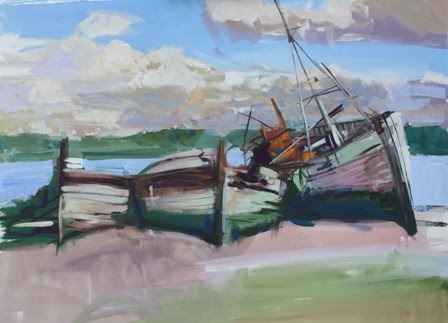
In my previous two blogs, I demonstrated en plein air landscape painting in gouache. Both were paintings of Pin Mill, a lovely spot on the Suffolk coast. Unfortunately, I was unable to complete either painting in one session due to weather and tide. I have since returned as well as doing more work in the studio. One of the paintings is now finished.
I have already shown the beginning and intermediate stages of the paintings, so I won’t dwell on lengthy explanations. ( For those see previous blogs)


The beginning of the painting


Intermediate stage of the gouache painting.


The finished painting.
As you will see, all areas have been worked on. The sky has been softened and blended. The distant shore has had more detail added. Small yachts have been introduced. The bulk of the work has been done on the hulks, scumbling to achieve the texture of the timbers or rust then working with a fine sable brush on top when more precision was required. Masts have been altered and rigging added. With large hog’s hair brushes, I painted the foreground fairly freely, and on occasions even employed a palette knife.
As I have said in previous blogs, gouache is a wonderful medium for working out of doors. It dries instantly, but remains water soluble. It is opaque and is therefore very forgiving. Any mistakes can be instantly obliterated. It has a lovely chalky quality about it , ideal for atmospheric effects. Its disadvantages? You can’t glaze with it and blending is difficult. A technique akin to tempera has to be adopted. But overall, its good points far outweigh such difficulties.

Monday, December 15, 2008

Painting a landscape in acrylics - part 1


This is a painting of the small village of Alcaufar, one of the places we visit in Menorca on Inspiration Holidays.

Initially, I do some quick compositional sketches in either pencil or charcoal. I am looking at the main masses, at the rhythms and lines running through the painting and how this all relates to the picture frame. I check for the Golden section (or Rule of Thirds) and patterns of light and shade. I find it invaluable to do all this preliminary work, to think about what I am painting and why, rather just sitting down and hoping for the best! On the Holiday, I encourage students to get into this way of working.
Moving on to the painting, I quickly establish the main masses of the composition. I do not do any preliminary drawing with pencil or charcoal, but go straight in with the brush. I am working in acrylics, but at this stage the paint is very fluid, almost like a watercolour.