It has been an incredibly busy start to 2012 with numerous portrait commissions, demonstrations to art societies and lots of new classes. Hence my blog has been somewhat neglected.
A new venture for me are two classes I am teaching at West Norfolk Arts Centre near King's Lynn.
Called "Paint in Any Media" they cover all media, from watercolours to oils, pastels, gouache. They are two very lively groups of students working in a diversity of subject matter and styles.
The classes are on Tuesdays from 10.30 - 12.30 and 1.30 - 3.30
For fuller details contact either Richard or Ros at the Centre on 01553 631 689 or check out their website at www.westnorfolkarts.co.uk
Showing posts with label gouache. Show all posts
Showing posts with label gouache. Show all posts
Friday, February 3, 2012


Sunday, August 14, 2011
Gouache Painting at West Norfolk Arts Centre
I recently made my second visit this year to West Norfolk Arts Centre. This time it was to teach the art of painting in gouache.
The first day was spent explaining the history of the medium and demonstrating techniques and materials. As a bit of fun I "copied" two paintings hanging in the studio. These were by other artists. One was an oil, the other a watercolour. It was simply to show how gouache interpreted the same scene in a very different way. The rest of the day was spent exploring the medium and working from references or photographs.
The following day, I did both a portrait demonstration and a landscape "en plein air". It was then time for the students to work outdoors. Fortunately, the sun was shining!


All in all a very successful weekend. Very few of the students had ever tried this medium and were delighted with its versatility and forgiving nature.
As usual, Ros and Richard Cartwright, Directors of the Centre were the perfect hosts with their close attention to detail and the warm welcome they extended to all.
My next visit to the Centre will be to teach "Portrait Painting made Easy" 28th - 30th October.
Thursday, December 9, 2010
Painting in the snow
On the positive side , this recent Arctic weather has provided amazing opportunities for painting en plein air. It is something I have done a lot of, even in near zero temperatures. On with the thermal underwear, the furry hat , the fingerless mittens and six layers of clothes and off one goes.
What could be more enchanting than to stand painting in splendid isolation, listening to the sound of silence. On a crystal clear day, the colours are amazing. The white of the snow is a myriad of colours- pinks blues, purples. How does one capture it?
It most certainly isn't for the faint hearted. I can well remember painting in Scotland once, during the worst winter in living memory. I was working in gouache and suddenly felt the paint was becoming difficult to manipulate, only to realise my medium was turning to ice on the surface of the board. It certainly gave some interesting effects when I took it back to the warmth of my cottage and the painting thawed out!
Here's one I did earlier!

The Abbey Gardens, Bury St. Edmunds. Oils 40" x 30"
What could be more enchanting than to stand painting in splendid isolation, listening to the sound of silence. On a crystal clear day, the colours are amazing. The white of the snow is a myriad of colours- pinks blues, purples. How does one capture it?
It most certainly isn't for the faint hearted. I can well remember painting in Scotland once, during the worst winter in living memory. I was working in gouache and suddenly felt the paint was becoming difficult to manipulate, only to realise my medium was turning to ice on the surface of the board. It certainly gave some interesting effects when I took it back to the warmth of my cottage and the painting thawed out!
Here's one I did earlier!

The Abbey Gardens, Bury St. Edmunds. Oils 40" x 30"
Sunday, October 17, 2010
Mixed Media 2
This time I thought I would create a painting using a combination of gouache and pastels. The reasoning behind this is that both mediums give very distinctive effects which are immensely suitable for the subject matter. The gouache I use when I need some precision or when I wish to take advantage of its painterly qualities, the pastel when I wish a softer , more blurred effect.

The support I have chosen is a fairly textured pastel paper in bright orange. It is a very deliberate choice as the subject matter is bold, colourful and full of movement. I block in the main composition in gouache, sometimes in a free, loose , almost watercolour technique. At other times I use a thicker impasto dragging it over the texture of the paper which can give beautiful broken, dappled effects.

I now apply pastel in broad strokes, and dabs and at other times blending and smoothing. The aim is to create the bright, almost garish light of a fairground and a huge sense of movement and energy as the merry go round spins by.

The finished painting.

The support I have chosen is a fairly textured pastel paper in bright orange. It is a very deliberate choice as the subject matter is bold, colourful and full of movement. I block in the main composition in gouache, sometimes in a free, loose , almost watercolour technique. At other times I use a thicker impasto dragging it over the texture of the paper which can give beautiful broken, dappled effects.

I now apply pastel in broad strokes, and dabs and at other times blending and smoothing. The aim is to create the bright, almost garish light of a fairground and a huge sense of movement and energy as the merry go round spins by.

The finished painting.
Saturday, September 25, 2010
West Norfolk Arts Centre
This week I was invited to teach two courses next year at West Norfolk Arts Centre.
The Centre is situated in the delightful conservation village of Castle Rising , close to the Sandringham estate, nature reserves, woodlands and the north Norfolk Coast.
Established in 1993 by Ros and Richard Cartwright, it enjoys an excellent reputation as a quality Painting Course provider both in the U.K. and abroad. Each year, approximately forty painting courses are held in West Norfolk and four structured painting courses abroad. This year, Egypt, Venice, Tuscany and Skiathos were on the itinerary.
The range of courses on offer is huge, from pen and wash to acrylics, oils, pastels, wildlife , abstraction, botanical painting etc.
In 2011, I will be teaching the following. " The art of Gouache Painting" July 23/24 and "Portraiture" October 28, 29, 30th.
For information on the west Norfolk Arts Centre and all the courses it runs go to www.westnorfolkartscentre.co.uk
The Centre is situated in the delightful conservation village of Castle Rising , close to the Sandringham estate, nature reserves, woodlands and the north Norfolk Coast.
Established in 1993 by Ros and Richard Cartwright, it enjoys an excellent reputation as a quality Painting Course provider both in the U.K. and abroad. Each year, approximately forty painting courses are held in West Norfolk and four structured painting courses abroad. This year, Egypt, Venice, Tuscany and Skiathos were on the itinerary.
The range of courses on offer is huge, from pen and wash to acrylics, oils, pastels, wildlife , abstraction, botanical painting etc.
In 2011, I will be teaching the following. " The art of Gouache Painting" July 23/24 and "Portraiture" October 28, 29, 30th.
For information on the west Norfolk Arts Centre and all the courses it runs go to www.westnorfolkartscentre.co.uk
Mixed media
It is on occasions, great fun to play around with different mediums and combining them in unusual ways. The monochrome painting below was done using charcoal, conte, soft chalk and gouache. It is of an old jetty at Felixstowe Ferry on the Suffolk coast.

I began with a piece of MDF which I primed with a couple of coats of acrylic gesso . I then sketched in the composition using charcoal. I used conte crayon for finer detail and soft chalks to soften and blend large areas like the sky. At other times I used gouache in certain passages, e.g. a lot of the background , but overlaid it in places with chalk.

I began with a piece of MDF which I primed with a couple of coats of acrylic gesso . I then sketched in the composition using charcoal. I used conte crayon for finer detail and soft chalks to soften and blend large areas like the sky. At other times I used gouache in certain passages, e.g. a lot of the background , but overlaid it in places with chalk.
Friday, September 4, 2009
Painting at Pin Mill 4
In a previous blog (August 10th) I demonstrated my methods for painting a gouache landscape en plein air. The subject was Pin Mill on the Suffolk Coast. Unfortunately, as I explained, “good light” stopped play.
To recap:


Stage two. At this point the painting had to be abandoned due to rain and wind!
Fortunately, I have since returned for another few hours to work on the painting and then complete it in the studio.

The finished painting.

Detail of finished painting.
As will be seen, a great deal of work has been done on the barges etc and on the water where I was hoping to capture the play of light and the patterns of reflections. At times I used hogs hair brushes, at others, softer synthetic ones which allowed me to blend much more easily. At the end I was using tiny sable brushes, to do areas such as the rigging.
As I said in my previous blog, working en plein air can be both exhilarating and challenging. If you haven’t already tried it , have a go!
Friday, August 21, 2009
Yesterday, I returned to Pin Mill in the hope of completing the painting I had started the previous day.
The block- in stage was complete. Now it was time to focus on more detail. Obviously, work was required on the barges and distant horizon. I also wanted to capture the reflections and play of light on the water.

But as Robert burns said ” The best- laid schemes o’ mice and men gang aft a-gley”. Unfortunately, good light stopped play. Instead of the brooding sky of the previous day, I was confronted by bright blue sky and white fluffy clouds! There was absolutely no way I could continue with the painting above . Everything was different, from the light to the colour, shadows and reflections! Painting en plein air can be very frustrating!
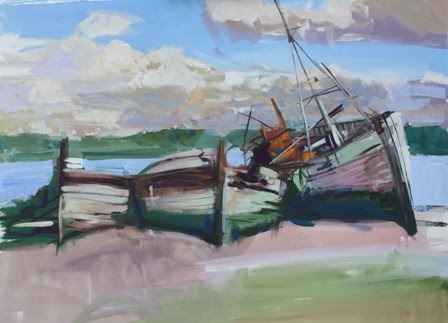
And so I had to move to plan B. Fortunately, I had come prepared to start another painting. Beyond the barges and houseboats, there are some marvellous old rotting hulks which appeal greatly. I love the decaying moss- covered timbers , the flaking paint , the rusting metalwork. Not the picture postcard view of Pin Mill , but equally fascinating.

My medium was still gouache, but this time I chose to work on a rough surfaced watercolour board (N.O.T.) The subject just cried out for it with all that decay and texture. As before, I went straight in with a large brush, geting the basic outlines and main masses. The pigment is still fluid. Olive green, ultramarine, burnt sienna and white were the colours used at this stage.

I move rapidly on to painting the sky, indicating the distant trees on the other side of the river, and ,of course the river itself. ( I am aware the horizon dips steeply to the left, but this will be corrected later) I have already indicated the foreground mud but decide to leave it and see what happens when the tide starts to come in. I concentrate on drawing the boats ( a tricky piece of perspective) looking at scale and shape. I begin to start painting thickly in places to suggest the texture of the timbers or flaking rust. Gouache is an ideal medium for this . It dries instantly and retains its impasto. But it remains water soluble and can thus be painted back into or even sponged off if required. A very forgiving medium indeed.

By now, after about 2 hours painting, the tide is rapidly moving in to engulf both the hulks and the artist! Suddenly, the subject becomes alive with the image of thes old boats, abandoned and stranded atop the sandbank. I very quickly indicate the approaching water and reflections on it.
It is now time to pack up paints and easel and retreat to dry land.
As before , I am now left with another unfinished painting, but the excitement of that initial image is still there.
With both these paintings I will go back and do more work en plein air as well as finishing off in the studio. I will show the completed works in a later blog.
Tips.
Working from photographs can not replace the excitement or energy required when painting on the spot. You are at the mercy of the elements and have to work at breackneck speed. You simply do not have time to fiddle around.
Be prepared for frustrations and always have a plan B, if not C at the ready.
Painting at Pin Mill 3
In my previous two blogs, I demonstrated en plein air landscape painting in gouache. Both were paintings of Pin Mill, a lovely spot on the Suffolk coast. Unfortunately, I was unable to complete either painting in one session due to weather and tide. I have since returned as well as doing more work in the studio. One of the paintings is now finished.
I have already shown the beginning and intermediate stages of the paintings, so I won’t dwell on lengthy explanations. ( For those see previous blogs)

The beginning of the painting
Intermediate stage of the gouache painting.

The finished painting.
As you will see, all areas have been worked on. The sky has been softened and blended. The distant shore has had more detail added. Small yachts have been introduced. The bulk of the work has been done on the hulks, scumbling to achieve the texture of the timbers or rust then working with a fine sable brush on top when more precision was required. Masts have been altered and rigging added. With large hog’s hair brushes, I painted the foreground fairly freely, and on occasions even employed a palette knife.
As I have said in previous blogs, gouache is a wonderful medium for working out of doors. It dries instantly, but remains water soluble. It is opaque and is therefore very forgiving. Any mistakes can be instantly obliterated. It has a lovely chalky quality about it , ideal for atmospheric effects. Its disadvantages? You can’t glaze with it and blending is difficult. A technique akin to tempera has to be adopted. But overall, its good points far outweigh such difficulties.
Wednesday, May 27, 2009
Sketching in gouache
Gouache is a marvellous medium for doing quick sketches. I often use it when working on portrait commissions and wish to present a series of ideas . In a previous blog, I showed a portrait of Tony Langford, Managing Director of John Smedley Ltd. (2003-9)
This was only arrived at after various other alternatives had been considered.

Whilst it was great fun to paint , this was not really a portrait suitable for the Company Boardroom.
Tony is also a passionate sailor, so I was taken on board his motor launch and given a trip along the Orwell. Fortunately, it was a calm day as I am no seafarer! This voyage resulted in the following sketch.

One of the previous Chairmen, however, also had a nautical theme as background, so this alternative was rejected.
Finally, we decided on a Cambridge setting as Tony grew up there,went to University there and now lives there. Hence the idea of having his old College, Clare, as the backdrop. A couple of alternatives were considered

Also

This second version was chosen as the design for the finished portrait. Whilst indicating the Cambridge connection the pose was also intentionally relaxed and casual. As such it was a good foil to previous portraits now hanging in the John Smedley Boardroom.
The finished portrait.

“Tony Langford, Chairman, John Smedley Ltd. ( 2003-9)
oils 38″x 30″
The advantages of gouache as a sketching medium.
It is water based and dries instantly but remains soluble if you wish to work back into it. You can paint with a thick impasto or using a wash technique. It is opaque so you can paint light over dark . As such it is a very forgiving medium. It is much underrated and is well worth experimenting with if you’ve never tried it before.
Saturday, February 28, 2009
Painting a landscape in gouache 1
Gouache is one of my favourite mediums, particularly for painting out of doors. It dries rapidly, yet is still water soluble if you wish to go back into it and make alterations. It has a soft chalky quality about it , French chalk having been added to the pigments in their production.
As a result , it is a very forgiving medium allowing one to proceed with the minimum of planning, to easily make amendments and to paint light over dark.
In this particular painting I am working on Bockingford watercolour board and using Winsor and Newton designers gouache.

With a large hog’s hair brush I have very rapidly blocked in the general composition, the sweep of the river, the distant hills and indicated the position of the trees in the foreground. It has taken around 30 minutes for this initial stage of the painting.
Subscribe to:
Posts (Atom)

 Posts
Posts

